Open-source RightAI Tools Directory
  • Discover AI
  • Submit
  • Startup
  • Blog
Open-source RightAI Tools Directory
Discover the best AI tools of 2025 with the RightAI Tools Directory!

Friend Links

AI Anime GeneratorToolsApp AI

Support

Tap4
Privacy policyTerms & ConditionsContact Us
Loading...
loading...

Agent K

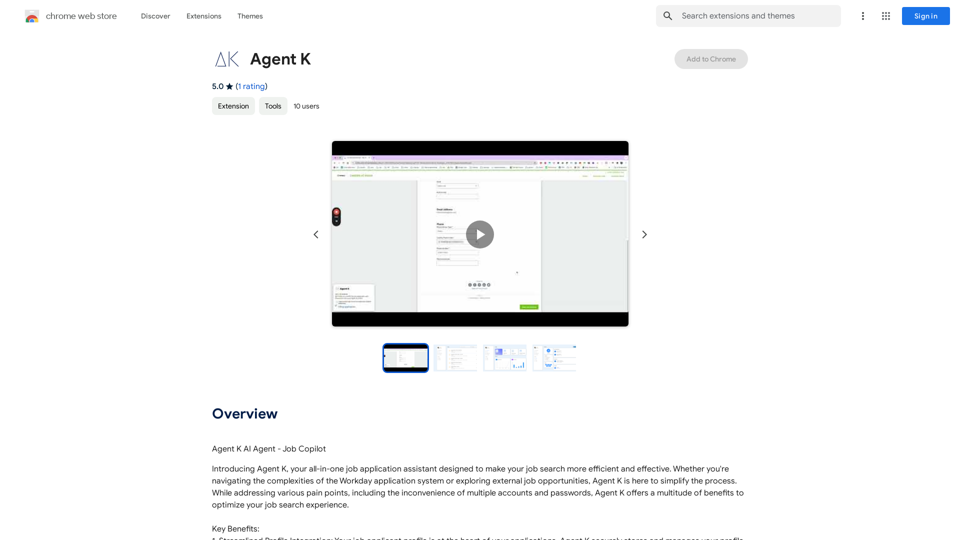
Agent K AI Agent - Job Copilot
Visit Website
Agent K
Visit Website

Introduction

Agent K is an AI-powered job application assistant designed to streamline the job search process. It simplifies profile management, offers single sign-on convenience, and automates job applications. By aggregating job listings from various sources and utilizing advanced automation, Agent K aims to save time and increase job seekers' chances of success.

Feature

Streamlined Profile Integration

Agent K securely stores and manages your job applicant profile information, eliminating repetitive data entry and ensuring accuracy.

Single Sign-On Convenience

Enjoy a seamless single sign-on experience, eliminating the need for multiple accounts and passwords across job platforms.

Effortless Application Management

AI-powered system auto-fills application forms, reducing errors and saving valuable time in the application process.

Comprehensive Job Discovery

Aggregates job listings from both Workday and external sources, providing a wide selection of opportunities.

Advanced Automation

Powerful bots work tirelessly to apply to thousands of relevant job opportunities, even while you sleep, increasing your chances of success.

Time-Saving Design

Streamlines the entire job application process, allowing users to focus on interview preparation and networking.

User-Centric Approach

Designed with user needs in mind, ensuring a friendly experience throughout the job search journey.

Security and Privacy

Prioritizes data confidentiality and protection, adhering to high security and privacy standards.

FAQ

What is Agent K?

Agent K is an AI-powered job application assistant that simplifies the job search process by streamlining profile management, offering single sign-on convenience, and automating job applications.

Is Agent K free to use?

Agent K offers a free version with limited features. A subscription plan is available for additional benefits and extended access beyond free usage limits.

How does Agent K ensure data security?

Agent K prioritizes data confidentiality and protection, handling user information with the highest level of security and privacy standards.

Can Agent K integrate with existing job search tools?

Yes, Agent K is designed to integrate with existing job search tools and platforms, enhancing the overall job search experience.

What are the key benefits of using Agent K?

Key benefits include time-saving through automation, comprehensive job discovery, streamlined profile management, and increased chances of success through advanced application features.

Latest Traffic Insights

  • Monthly Visits

    193.90 M

  • Bounce Rate

    56.27%

  • Pages Per Visit

    2.71

  • Time on Site(s)

    115.91

  • Global Rank

    -

  • Country Rank

    -

Recent Visits

Traffic Sources

  • Social Media:
    0.48%
  • Paid Referrals:
    0.55%
  • Email:
    0.15%
  • Referrals:
    12.81%
  • Search Engines:
    16.21%
  • Direct:
    69.81%
More Data

Related Websites

Text to Voice Generator
==========================

A text-to-voice generator, also known as a text-to-speech (TTS) system, is a software that converts written text into a spoken voice output. This technology has been widely used in various applications, including virtual assistants, audiobooks, and language learning platforms.

How it Works
---------------

The process of generating voice from text involves several steps:

1. Text Analysis: The input text is analyzed to identify the language, syntax, and semantics.
2. Phonetic Transcription: The text is converted into a phonetic transcription, which represents the sounds of the spoken language.
3. Prosody Generation: The phonetic transcription is then used to generate the prosody, or rhythm and intonation, of the spoken voice.
4. Waveform Generation: The prosody and phonetic transcription are combined to generate the audio waveform, which is the final spoken voice output.

Types of Text-to-Voice Generators
-----------------------------------

There are two main types of text-to-voice generators:

Rule-Based Systems

These systems use a set of predefined rules to generate the spoken voice output. They are often limited in their ability to produce natural-sounding voices and may sound robotic.

Machine Learning-Based Systems

These systems use machine learning algorithms to learn from large datasets of spoken voices and generate more natural-sounding voices. They are often more advanced and can produce high-quality voice outputs.

Applications of Text-to-Voice Generators
-----------------------------------------

Text-to-voice generators have a wide range of applications, including:

Virtual Assistants

Virtual assistants, such as Siri and Alexa, use text-to-voice generators to respond to user queries.

Audiobooks

Text-to-voice generators can be used to create audiobooks from written texts, making it easier for people to access written content.

Language Learning

Language learning platforms use text-to-voice generators to provide pronunciation guidance and practice exercises for learners.

Accessibility

Text-to-voice generators can be used to assist people with disabilities, such as visual impairments, by providing an auditory interface to written content.
View Detail

Text to Voice Generator ========================== A text-to-voice generator, also known as a text-to-speech (TTS) system, is a software that converts written text into a spoken voice output. This technology has been widely used in various applications, including virtual assistants, audiobooks, and language learning platforms. How it Works --------------- The process of generating voice from text involves several steps: 1. Text Analysis: The input text is analyzed to identify the language, syntax, and semantics. 2. Phonetic Transcription: The text is converted into a phonetic transcription, which represents the sounds of the spoken language. 3. Prosody Generation: The phonetic transcription is then used to generate the prosody, or rhythm and intonation, of the spoken voice. 4. Waveform Generation: The prosody and phonetic transcription are combined to generate the audio waveform, which is the final spoken voice output. Types of Text-to-Voice Generators ----------------------------------- There are two main types of text-to-voice generators: Rule-Based Systems These systems use a set of predefined rules to generate the spoken voice output. They are often limited in their ability to produce natural-sounding voices and may sound robotic. Machine Learning-Based Systems These systems use machine learning algorithms to learn from large datasets of spoken voices and generate more natural-sounding voices. They are often more advanced and can produce high-quality voice outputs. Applications of Text-to-Voice Generators ----------------------------------------- Text-to-voice generators have a wide range of applications, including: Virtual Assistants Virtual assistants, such as Siri and Alexa, use text-to-voice generators to respond to user queries. Audiobooks Text-to-voice generators can be used to create audiobooks from written texts, making it easier for people to access written content. Language Learning Language learning platforms use text-to-voice generators to provide pronunciation guidance and practice exercises for learners. Accessibility Text-to-voice generators can be used to assist people with disabilities, such as visual impairments, by providing an auditory interface to written content.

Text to Voice Generator ========================== A text-to-voice generator, also known as a text-to-speech (TTS) system, is a software that converts written text into a spoken voice output. This technology has been widely used in various applications, including virtual assistants, audiobooks, and language learning platforms. How it Works --------------- The process of generating voice from text involves several steps: 1. Text Analysis: The input text is analyzed to identify the language, syntax, and semantics. 2. Phonetic Transcription: The text is converted into a phonetic transcription, which represents the sounds of the spoken language. 3. Prosody Generation: The phonetic transcription is then used to generate the prosody, or rhythm and intonation, of the spoken voice. 4. Waveform Generation: The prosody and phonetic transcription are combined to generate the audio waveform, which is the final spoken voice output. Types of Text-to-Voice Generators ----------------------------------- There are two main types of text-to-voice generators: Rule-Based Systems These systems use a set of predefined rules to generate the spoken voice output. They are often limited in their ability to produce natural-sounding voices and may sound robotic. Machine Learning-Based Systems These systems use machine learning algorithms to learn from large datasets of spoken voices and generate more natural-sounding voices. They are often more advanced and can produce high-quality voice outputs. Applications of Text-to-Voice Generators ----------------------------------------- Text-to-voice generators have a wide range of applications, including: Virtual Assistants Virtual assistants, such as Siri and Alexa, use text-to-voice generators to respond to user queries. Audiobooks Text-to-voice generators can be used to create audiobooks from written texts, making it easier for people to access written content. Language Learning Language learning platforms use text-to-voice generators to provide pronunciation guidance and practice exercises for learners. Accessibility Text-to-voice generators can be used to assist people with disabilities, such as visual impairments, by providing an auditory interface to written content.

Generate Voice from Text on Any Web Page With the advancement of technology, it is now possible to generate voice from text on any web page. This feature is particularly useful for people who prefer listening to content rather than reading it. Here's how you can do it: #Method 1: Using Browser Extension You can use a browser extension like Read Aloud or SpeakIt! to generate voice from text on any web page. These extensions are available for both Google Chrome and Mozilla Firefox browsers. #Method 2: Using Online Tools There are several online tools available that can convert text to speech. Some popular tools include NaturalReader, Voice Dream Reader, and Google Text-to-Speech. You can copy and paste the text from any web page into these tools to generate voice. #Method 3: Using Screen Reader If you are using a Windows operating system, you can use the built-in Narrator screen reader to generate voice from text on any web page. For Mac users, you can use VoiceOver. By using any of these methods, you can easily generate voice from text on any web page and enjoy a more convenient and accessible reading experience.

193.90 M
Nude AI Generator – Uncensored AI Image Generator
View Detail

Nude AI Generator – Uncensored AI Image Generator

Nude AI Generator – Uncensored AI Image Generator

Nude AI Generator is an advanced tool designed to create custom adult artwork using artificial intelligence.

11.06 K
FLUX.1 AI: Advanced Text-to-Image Generation Model
View Detail

FLUX.1 AI: Advanced Text-to-Image Generation Model

FLUX.1 AI: Advanced Text-to-Image Generation Model

Experience the next level of image synthesis with FLUX.1 AI. Our cutting-edge AI technology creates stunning, diverse, and highly detailed images from text prompts.

152
FLUX Redux - A Professional Tool for Generating AI Images
View Detail

FLUX Redux - A Professional Tool for Generating AI Images

FLUX Redux - A Professional Tool for Generating AI Images

FLUX Redux is an enterprise-level AI image processing tool that provides advanced features for generating variations, restyling, and enhancing images.

0
Flux-1
View Detail

Flux-1

Flux-1

FLUX.1 is a new open-source image generation model developed by Black Forest Labs

12.83 K
meetXcc: AI Meeting Notes for Google Meet
View Detail

meetXcc: AI Meeting Notes for Google Meet

meetXcc: AI Meeting Notes for Google Meet

Automated meeting documentation via transcripts, summaries and intuitive AI-generated mind maps.

193.90 M
AI Playground
View Detail

AI Playground

AI Playground

Gan AI Playground is a developer-focused platform offering advanced AI tools and technologies.

0
AI Image Editor │ Free Comprehensive Photo AI Tools
View Detail

AI Image Editor │ Free Comprehensive Photo AI Tools

AI Image Editor │ Free Comprehensive Photo AI Tools

AIImageEditor.me offers 12 Free AI image tools—from image enhancement and watermark removal to style transfer and background editing—to simplify image editing.

21.99 K