Open-source RightAI Tools Directory
  • Discover AI
  • Submit
  • Startup
  • Blog
Open-source RightAI Tools Directory
Discover the best AI tools of 2025 with the RightAI Tools Directory!

Friend Links

AI Anime GeneratorToolsApp AI

Support

Tap4
Privacy policyTerms & ConditionsContact Us
Loading...
loading...

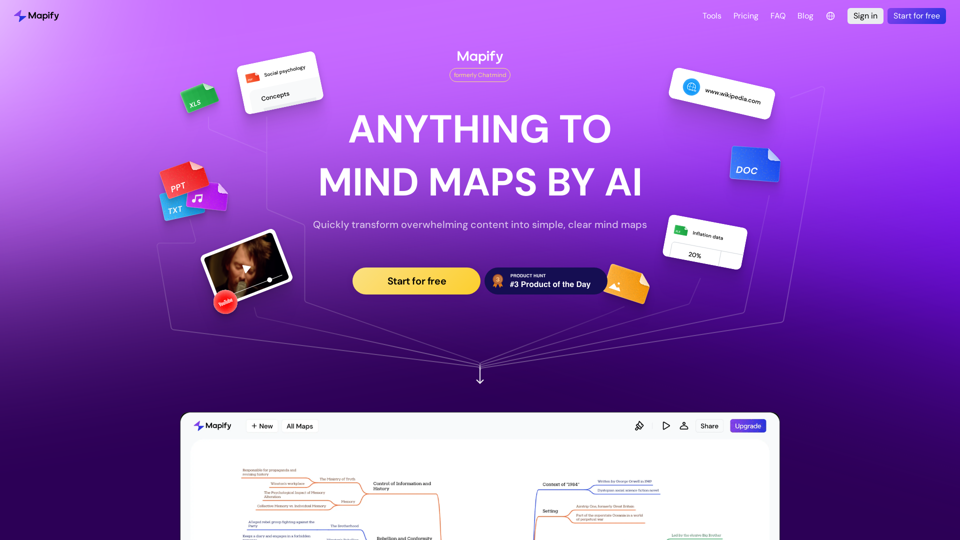
Mapify: Transform Anything to Mind Maps by AI, formerly Chatmind

Mapify, upgraded from Chatmind by the Xmind Team, is a free online mind mapping and brainstorming tool powered by AI. It can summarize PDF, Word, PowerPoint, YouTube, long text, and images into mind maps in just a few minutes.
Visit Website
Mapify: Transform Anything to Mind Maps by AI, formerly Chatmind
Visit Website

Introduction

Mapify is an AI-driven platform that transforms content into mind maps, simplifying the organization and visualization of complex information. It offers an intuitive interface for creating and customizing mind maps, real-time collaboration features, and various export options. Mapify caters to individuals and teams looking to enhance productivity and streamline information processing.

Feature

AI-powered Mind Mapping

Mapify utilizes artificial intelligence to generate mind maps from various content types, including text, images, and audio.

Intuitive User Interface

The platform features an easy-to-use interface that allows users to create and customize mind maps effortlessly.

Real-time Collaboration

Mapify enables multiple users to work together on a mind map in real-time, fostering teamwork and idea sharing.

Chatbot Integration

A built-in chatbot interacts with your mind map, providing additional insights and suggestions to enhance your work.

Flexible Export Options

Users can export their mind maps in various formats, including images, PDFs, and presentations, for easy sharing and distribution.

Customizable Templates

Choose from pre-designed templates or create custom templates to suit your specific needs and preferences.

Multi-content Support

Mapify supports various content types, including text, images, audio, and video, making it versatile for different use cases.

FAQ

What types of content can I use with Mapify?

Mapify supports a wide range of content types, including text, images, audio, and video.

How does the collaboration feature work?

Mapify enables real-time collaboration, allowing multiple users to work together on a mind map simultaneously.

What export options are available?

You can export your mind maps in various formats, including images, PDFs, and presentations.

Is Mapify secure?

Yes, Mapify prioritizes security with enterprise-grade encryption and secure data storage.

What are the pricing options for Mapify?

Mapify offers multiple pricing tiers:

PlanPriceFeatures
Free$010 mind maps/month, limited collaboration
Basic$9.99/monthUnlimited mind maps, real-time collaboration, export options
Pro$29.99/monthAdvanced analytics, custom branding
EnterpriseCustom pricingFor large teams and organizations

How can I get started with Mapify?

To begin using Mapify:

  1. Upload your content (text, images, or audio) to the platform
  2. Choose a template or create a custom one
  3. Customize your mind map using the intuitive interface
  4. Collaborate with others in real-time if needed
  5. Export and share your completed mind map

Related Websites
UniOne AI
View Detail

UniOne AI

UniOne AI

UniOne AI is an AI assistant that integrates several AI services such as GPT3.5, GPT4, Claude 3, Gemini Pro and more!

193.90 M
Text to Voice Generator
==========================

A text-to-voice generator, also known as a text-to-speech (TTS) system, is a software that converts written text into a spoken voice output. This technology has been widely used in various applications, including virtual assistants, audiobooks, and language learning platforms.

How it Works
---------------

The process of generating voice from text involves several steps:

1. Text Analysis: The input text is analyzed to identify the language, syntax, and semantics.
2. Phonetic Transcription: The text is converted into a phonetic transcription, which represents the sounds of the spoken language.
3. Prosody Generation: The phonetic transcription is then used to generate the prosody, or rhythm and intonation, of the spoken voice.
4. Waveform Generation: The prosody and phonetic transcription are combined to generate the audio waveform, which is the final spoken voice output.

Types of Text-to-Voice Generators
-----------------------------------

There are two main types of text-to-voice generators:

Rule-Based Systems

These systems use a set of predefined rules to generate the spoken voice output. They are often limited in their ability to produce natural-sounding voices and may sound robotic.

Machine Learning-Based Systems

These systems use machine learning algorithms to learn from large datasets of spoken voices and generate more natural-sounding voices. They are often more advanced and can produce high-quality voice outputs.

Applications of Text-to-Voice Generators
-----------------------------------------

Text-to-voice generators have a wide range of applications, including:

Virtual Assistants

Virtual assistants, such as Siri and Alexa, use text-to-voice generators to respond to user queries.

Audiobooks

Text-to-voice generators can be used to create audiobooks from written texts, making it easier for people to access written content.

Language Learning

Language learning platforms use text-to-voice generators to provide pronunciation guidance and practice exercises for learners.

Accessibility

Text-to-voice generators can be used to assist people with disabilities, such as visual impairments, by providing an auditory interface to written content.
View Detail

Text to Voice Generator ========================== A text-to-voice generator, also known as a text-to-speech (TTS) system, is a software that converts written text into a spoken voice output. This technology has been widely used in various applications, including virtual assistants, audiobooks, and language learning platforms. How it Works --------------- The process of generating voice from text involves several steps: 1. Text Analysis: The input text is analyzed to identify the language, syntax, and semantics. 2. Phonetic Transcription: The text is converted into a phonetic transcription, which represents the sounds of the spoken language. 3. Prosody Generation: The phonetic transcription is then used to generate the prosody, or rhythm and intonation, of the spoken voice. 4. Waveform Generation: The prosody and phonetic transcription are combined to generate the audio waveform, which is the final spoken voice output. Types of Text-to-Voice Generators ----------------------------------- There are two main types of text-to-voice generators: Rule-Based Systems These systems use a set of predefined rules to generate the spoken voice output. They are often limited in their ability to produce natural-sounding voices and may sound robotic. Machine Learning-Based Systems These systems use machine learning algorithms to learn from large datasets of spoken voices and generate more natural-sounding voices. They are often more advanced and can produce high-quality voice outputs. Applications of Text-to-Voice Generators ----------------------------------------- Text-to-voice generators have a wide range of applications, including: Virtual Assistants Virtual assistants, such as Siri and Alexa, use text-to-voice generators to respond to user queries. Audiobooks Text-to-voice generators can be used to create audiobooks from written texts, making it easier for people to access written content. Language Learning Language learning platforms use text-to-voice generators to provide pronunciation guidance and practice exercises for learners. Accessibility Text-to-voice generators can be used to assist people with disabilities, such as visual impairments, by providing an auditory interface to written content.

Text to Voice Generator ========================== A text-to-voice generator, also known as a text-to-speech (TTS) system, is a software that converts written text into a spoken voice output. This technology has been widely used in various applications, including virtual assistants, audiobooks, and language learning platforms. How it Works --------------- The process of generating voice from text involves several steps: 1. Text Analysis: The input text is analyzed to identify the language, syntax, and semantics. 2. Phonetic Transcription: The text is converted into a phonetic transcription, which represents the sounds of the spoken language. 3. Prosody Generation: The phonetic transcription is then used to generate the prosody, or rhythm and intonation, of the spoken voice. 4. Waveform Generation: The prosody and phonetic transcription are combined to generate the audio waveform, which is the final spoken voice output. Types of Text-to-Voice Generators ----------------------------------- There are two main types of text-to-voice generators: Rule-Based Systems These systems use a set of predefined rules to generate the spoken voice output. They are often limited in their ability to produce natural-sounding voices and may sound robotic. Machine Learning-Based Systems These systems use machine learning algorithms to learn from large datasets of spoken voices and generate more natural-sounding voices. They are often more advanced and can produce high-quality voice outputs. Applications of Text-to-Voice Generators ----------------------------------------- Text-to-voice generators have a wide range of applications, including: Virtual Assistants Virtual assistants, such as Siri and Alexa, use text-to-voice generators to respond to user queries. Audiobooks Text-to-voice generators can be used to create audiobooks from written texts, making it easier for people to access written content. Language Learning Language learning platforms use text-to-voice generators to provide pronunciation guidance and practice exercises for learners. Accessibility Text-to-voice generators can be used to assist people with disabilities, such as visual impairments, by providing an auditory interface to written content.

Generate Voice from Text on Any Web Page With the advancement of technology, it is now possible to generate voice from text on any web page. This feature is particularly useful for people who prefer listening to content rather than reading it. Here's how you can do it: #Method 1: Using Browser Extension You can use a browser extension like Read Aloud or SpeakIt! to generate voice from text on any web page. These extensions are available for both Google Chrome and Mozilla Firefox browsers. #Method 2: Using Online Tools There are several online tools available that can convert text to speech. Some popular tools include NaturalReader, Voice Dream Reader, and Google Text-to-Speech. You can copy and paste the text from any web page into these tools to generate voice. #Method 3: Using Screen Reader If you are using a Windows operating system, you can use the built-in Narrator screen reader to generate voice from text on any web page. For Mac users, you can use VoiceOver. By using any of these methods, you can easily generate voice from text on any web page and enjoy a more convenient and accessible reading experience.

193.90 M
Image Describer - Free AI to Describe Images Online (No Login Required)
View Detail

Image Describer - Free AI to Describe Images Online (No Login Required)

Image Describer - Free AI to Describe Images Online (No Login Required)

Discover AI-Powered Image Descriptions with Image Describer. Gain Instant Insights and Unlock New Perspectives and Efficiency for Your Work and Creations. Join Us Today!

25.53 K
Video Editor 2024 and Other Cool Programs from Movavi – Download for Free
View Detail

Video Editor 2024 and Other Cool Programs from Movavi – Download for Free

Video Editor 2024 and Other Cool Programs from Movavi – Download for Free

Movavi offers fast and easy-to-use photo and video editing software that is safe and trusted worldwide. Try it all out for free!

3.27 M
AI Playground
View Detail

AI Playground

AI Playground

Gan AI Playground is a developer-focused platform offering advanced AI tools and technologies.

0
Socratic Lab
View Detail

Socratic Lab

Socratic Lab

Socratic Lab is your AI-powered community for learning and sharing knowledge. Ask anything you're curious about, connect with like-minded individuals, and join in-depth discussions.

2.71 K
SellingPilot - Your AI-powered assistant for e-commerce.
View Detail

SellingPilot - Your AI-powered assistant for e-commerce.

SellingPilot - Your AI-powered assistant for e-commerce.

SellingPilot is your AI-powered assistant for e-commerce. It helps you streamline your operations and accelerate your e-commerce business.

193.90 M
AI Image Enlarger | Enlarge Images Without Losing Quality!
View Detail

AI Image Enlarger | Enlarge Images Without Losing Quality!

AI Image Enlarger | Enlarge Images Without Losing Quality!

AI Image Enlarger is a FREE online tool for automatically upscaling and enhancing small images. It can make jpg/png pictures larger without compromising quality.

614.68 K