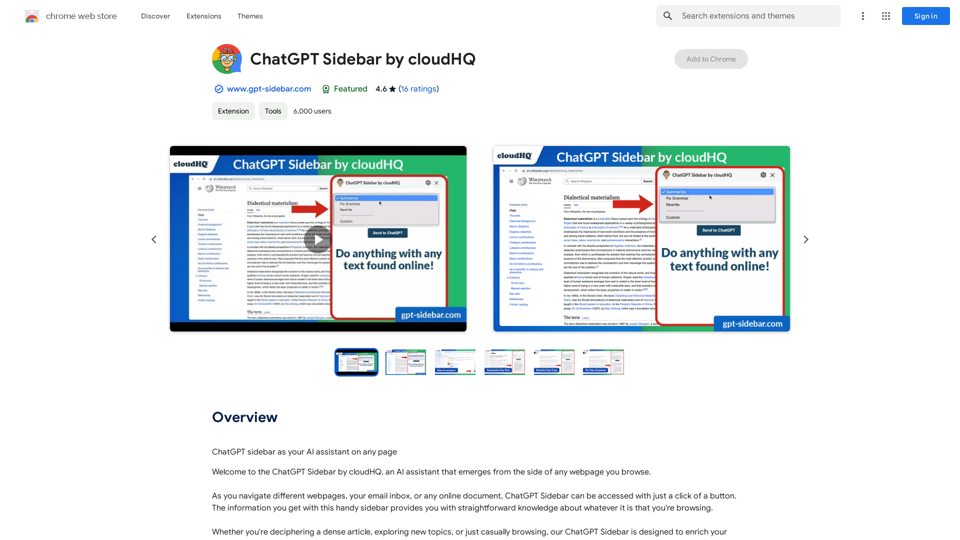
ChatGPT Sidebar is an innovative AI assistant that integrates seamlessly with your web browsing experience. This powerful tool appears on the side of any webpage, offering instant knowledge and assistance related to the content you're viewing. Whether you're tackling complex articles, exploring new subjects, or simply browsing casually, ChatGPT Sidebar enhances your online experience with AI-powered insights and functionality.
ChatGPT Sidebar by cloudHQ This is a powerful tool that brings the capabilities of ChatGPT directly into your workflow. Key Features: * Seamless Integration: Effortlessly access ChatGPT within your favorite applications like Gmail, Slack, and Notion. * Contextual Understanding: ChatGPT remembers past interactions, providing relevant and coherent responses within the context of your current task. * Boost Productivity: Automate repetitive tasks, generate creative content, and get instant answers to your questions, all without leaving your workspace. * Enhanced Collaboration: Share ChatGPT-powered insights and ideas with your team, fostering more productive and efficient collaboration. Benefits: * Save Time and Effort: Streamline your workflow and focus on high-value tasks. * Unlock Creativity: Overcome writer's block and generate innovative ideas. * Improve Communication: Craft clear, concise, and engaging messages. * Make Informed Decisions: Access reliable information and insights to support your decision-making process. Get Started Today: Visit our website to learn more and start using ChatGPT Sidebar by cloudHQ.
ChatGPT sidebar as your AI assistant on any page
Introduction
Feature
AI-Powered Web Assistance
ChatGPT Sidebar provides straightforward knowledge about any webpage you're browsing, helping you decipher dense articles, explore new topics, or enhance casual browsing.
Versatile Prompt Functionality
Use ChatGPT prompts across websites for various tasks:
- Summarizing content
- Rewriting text
- Grammar checking
- Translation
- Code clarification
- Webpage summarization
Customizable Prompt Library
Access a ready-to-use prompt library with the ability to further customize prompts for specific needs.
Comprehensive ChatGPT Support
Full support for both ChatGPT-4 and ChatGPT-3.5 models, ensuring access to the latest AI capabilities.
OpenAI API Integration
Complete support for the OpenAI API, allowing for advanced functionality and customization.
Prompt Management
Robust prompt management features for organizing and optimizing your AI interactions.
Easy-to-Use Interface
Simple three-step process:
- Visit any website
- Select the desired text
- Click the ChatGPT Sidebar icon and choose a prompt
FAQ
How do I use ChatGPT Sidebar?
To use ChatGPT Sidebar:
- Navigate to any website
- Select the text you want to analyze
- Click on the ChatGPT Sidebar icon on the right side of your screen
- Select a prompt and click "Send to ChatGPT"
What are the key benefits of using ChatGPT Sidebar?
The main benefits include:
- Cross-website ChatGPT prompt usage for various tasks
- Access to a customizable prompt library
- Full support for ChatGPT-4 and ChatGPT-3.5 models
How can I get started with ChatGPT Sidebar?
To get started:
- Download and install the extension from the Chrome Web Store
- Follow the setup prompts to create your account
- Begin using ChatGPT Sidebar on any webpage
Where can I find pricing information for ChatGPT Sidebar?
Pricing details are available on the official website: https://www.gpt-sidebar.com/pricing
Related Websites
AiJobster - Job Search in AI Companies and Remote AI Jobs
AiJobster - Job Search in AI Companies and Remote AI JobsAiJobster - Your premier platform for job search in AI companies and remote jobs across top AI-driven organizations. Discover your future in tech today!
694
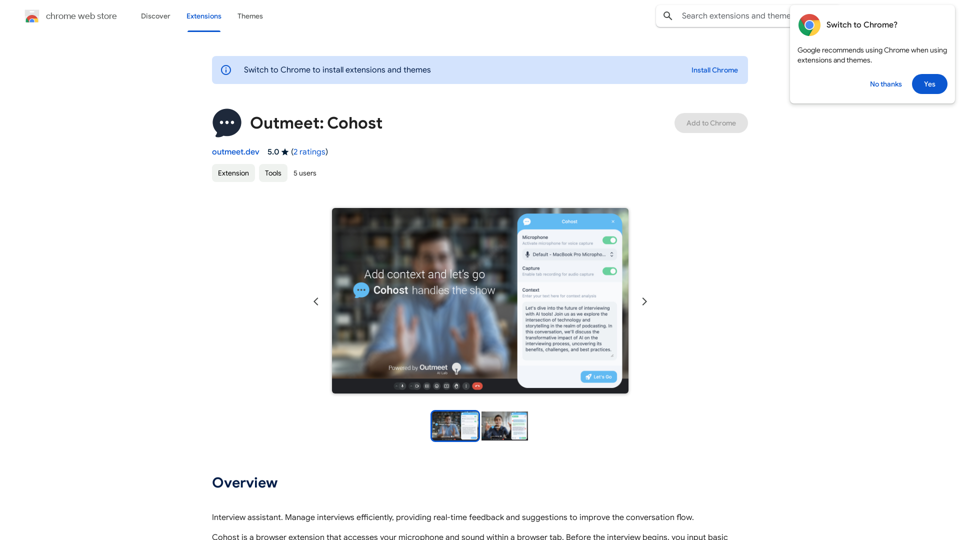
Interview assistant. Manage interviews efficiently, providing real-time feedback and suggestions to improve the conversation flow.
193.90 M
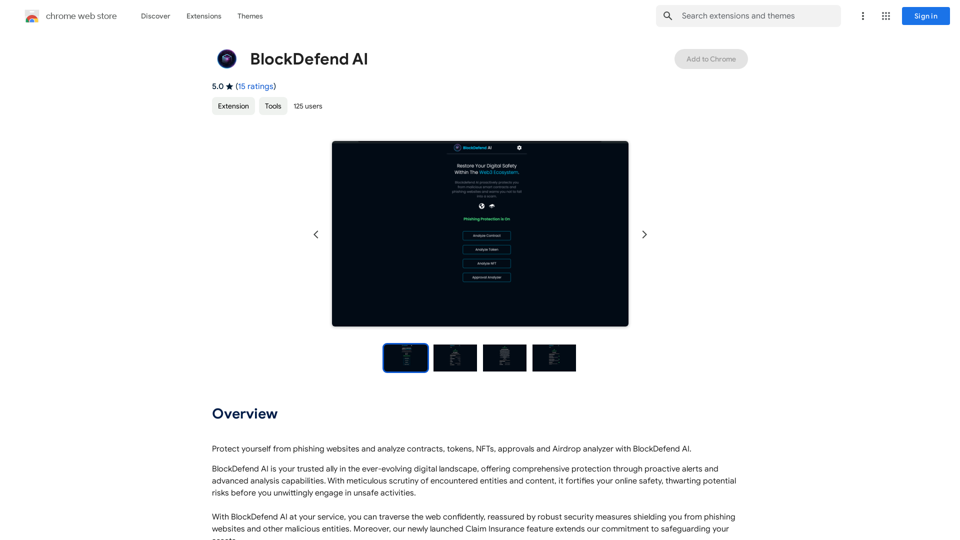
Protect yourself from phishing websites and analyze contracts, tokens, NFTs, approvals, and airdrops with BlockDefend AI.
193.90 M
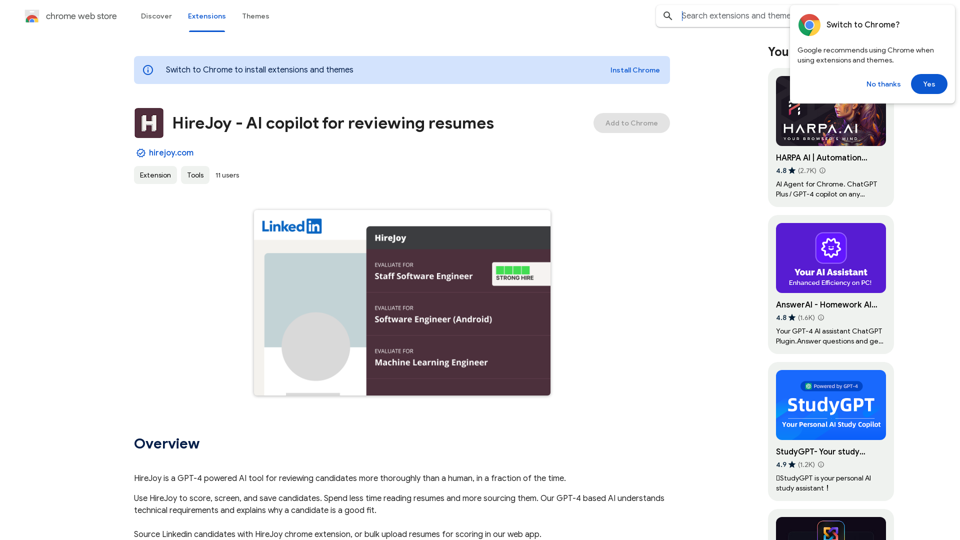
HireJoy is an AI tool powered by GPT-4 that can review candidates more completely than a person, in a much shorter amount of time.
193.90 M
Chat with Web-LLM Models in the Browser You can interact with Web-LLM models directly in your web browser without requiring any additional setup or installation. This allows you to easily experiment with and explore the capabilities of these models. Getting Started To get started, simply open a web browser and navigate to the Web-LLM model's website or platform. Once you're on the website, you can usually find a chat interface or text input field where you can enter your prompts or questions. How it Works When you enter a prompt or question, the Web-LLM model processes your input and generates a response. This response is then displayed in the chat interface or output field, allowing you to read and interact with the model's output. Benefits The benefits of chatting with Web-LLM models in the browser include: * Convenience: No need to install any software or set up any development environments. * Accessibility: Anyone with a web browser can interact with the model, regardless of their technical expertise. * Ease of use: The chat interface provides a user-friendly way to interact with the model, making it easy to experiment and explore its capabilities. Use Cases Some potential use cases for chatting with Web-LLM models in the browser include: * Research and development: Quickly experiment with different models and prompts to explore their capabilities and limitations. * Education and learning: Use the chat interface to teach students about AI and language models, or to provide interactive learning experiences. * Creative writing and ideation: Use the model as a tool to generate ideas, write stories, or create poetry. Overall, chatting with Web-LLM models in the browser provides a convenient and accessible way to interact with these powerful language models, and can be a valuable tool for a wide range of applications.
2.59 K
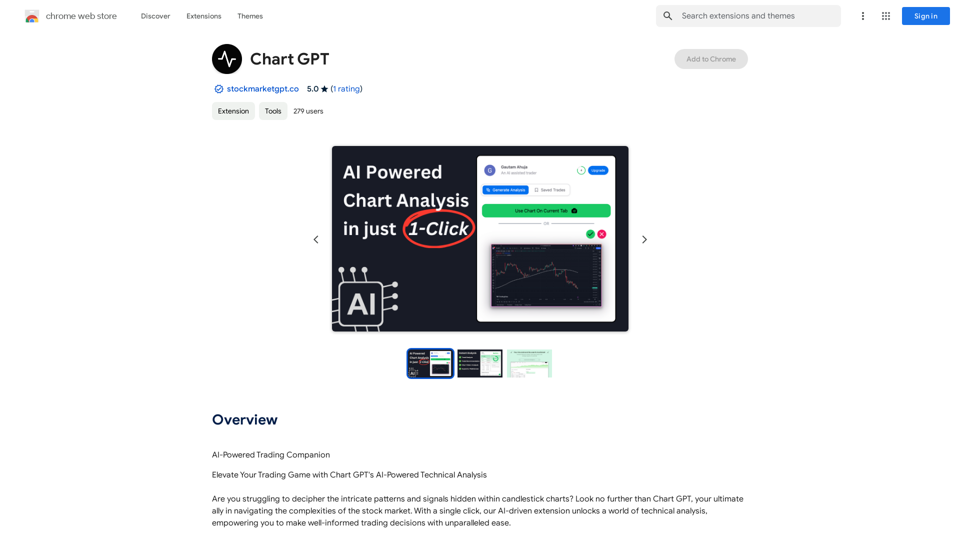
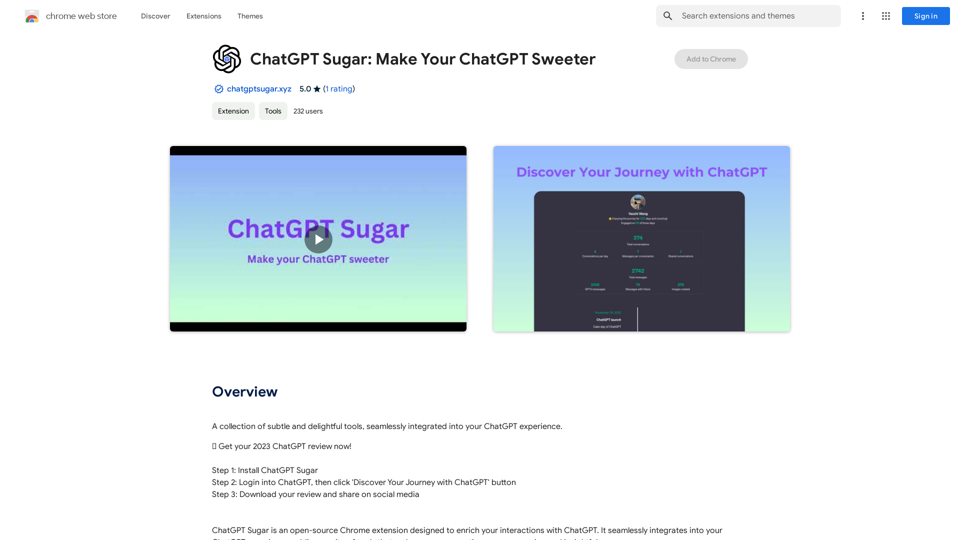
A collection of subtle and delightful tools, seamlessly integrated into your ChatGPT experience.
193.90 M